

FAQ – Frequently asked questions
Here you will find answers to frequently asked questions.
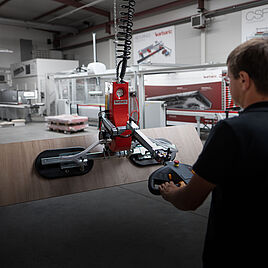
Vacuum handling is a lifting method that uses suction force to grip, lift, and transport objects. A vacuum pump or ejector creates negative pressure, allowing suction cups to adhere to surfaces. When the vacuum is released, the object is gently placed down. This method is commonly used in industrial applications for handling materials such as glass, wood panels, metal sheets, and stone slabs.
Vacuum pressures in lifting systems are typically measured in millibar (mbar) or inches of mercury (inHg).
- Most industrial vacuum lifters operate at a vacuum level of -0.4 to -0.9 bar (40% to 90% vacuum).
- A typical vacuum level for handling porous materials like MDF might be -0.4 bar (~60% vacuum), while for non-porous materials like glass, it can go as high as -0.9 bar (~90% vacuum).
- The exact pressure depends on the weight, material, and surface characteristics of the object being lifted.
Vacuum handling offers several benefits over traditional mechanical lifting, including:
- Non-damaging – No clamps or hooks, reducing the risk of surface scratches or dents.
- Increased efficiency – Faster lifting and positioning, improving workflow speed.
- Better ergonomics – Reduces manual lifting strain on workers.
- Adaptability – Can lift a wide variety of materials, including glass, wood, and sheet metal.
- Energy efficiency – Many systems include energy-saving vacuum pumps that optimize power usage.
Yes, vacuum lifters can handle loads ranging from a few kilograms to several tons. The lifting capacity depends on:
- The vacuum level achieved.
- The number and size of suction cups.
- The material type (porous materials require more suction flow).
Industrial-grade vacuum lifters, like those offered by Barbaric, are designed for heavy-duty applications, including large glass sheets, wood panels, and metal sheets.
Modern vacuum handling systems integrate several safety mechanisms:
- Vacuum sensors – Continuously monitor vacuum levels to prevent accidental drops.
- Warning alarms – Alert operators in case of a sudden loss of vacuum.
- Backup vacuum reservoirs – Ensure continued suction in case of power failure.
- Two-hand control systems – Prevent accidental releases by requiring both hands for operation.
- Check valves and fail-safe mechanisms – Ensure objects are held securely even in case of a power failure.
In vacuum handling, “vacuum” refers to a pressure lower than atmospheric pressure. The difference between the ambient pressure and the vacuum inside the suction cup generates the necessary force to hold and lift an object. The stronger the vacuum (i.e., the lower the pressure inside the system), the greater the lifting force.
A suction cup is a flexible rubber or silicone attachment that creates an airtight seal when pressed against a surface. When air is removed from inside the cup (using a vacuum pump or ejector), it generates suction force, allowing the object to be lifted. Suction cups come in different materials and shapes to accommodate different surfaces, including flat, textured, or porous materials.
A typical vacuum handling system consists of:
- Vacuum generator (pump or ejector) – Creates the negative pressure.
- Suction cups – Attach to the object and maintain the vacuum seal.
- Control valves – Regulate vacuum application and release.
- Safety sensors – Monitor vacuum levels and alert operators to potential issues.
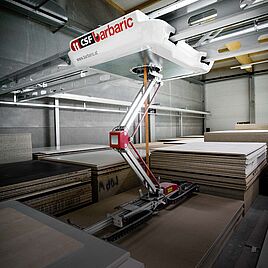
- Frame or lifting mechanism – Provides structural support and movement, often attached to cranes, robotic arms, or gantry systems.
Porous materials allow some air to pass through, which can make vacuum handling more challenging. To counteract this, vacuum systems use:
- High-flow vacuum generators to continuously compensate for air leakage.
- Specialized suction cups with foam seals to improve surface contact.
- Larger suction areas to distribute vacuum force more evenly.
With the right setup, even materials like MDF, OSB, or perforated sheets can be lifted efficiently.
Vacuum handling is used across multiple industries, including:
- Manufacturing – Handling of panels, sheets, and finished products.
- Glass Industry – Safe transportation and installation of large glass sheets.
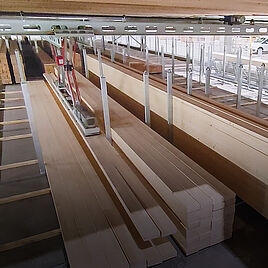
- Woodworking – Efficient handling of MDF, plywood, and laminated panels.
- Automotive – Moving vehicle parts and windshields.
- Logistics & Warehousing – Lifting boxes and packages for automated storage systems.
- Construction – Installation of large tiles, drywall, and cladding panels.
Detailed information about our individual products can be found on the corresponding information pages!

General contact information
Customer contact is a top priority to us. For general inquiries we are available during our opening hours through phone, e-mail or contact form:
Email: office@barbaric.at
Phone: +43 732 779800
Our opening hours:
Monday to Thursday: 07:00-12:00 and 13:00-16:00
Friday: 07:00-12:00